Craft Your Adventure: Travel Junk Journal Kit & Canva
If you’ve ever tried to build a cohesive brand identity for a travel blog, a boutique agency, or a lifestyle product line, you know the struggle of finding design assets that don’t look like everyone else’s. Stock photos often feel sterile, and generic clipart lacks the soul required for authentic storytelling. This is where the Travel Junk Journal Kit + Canva Template enters the picture, offering a bridge between the tactile, nostalgic world of scrapbooking and the efficiency of modern digital design. It isn't just a collection of files; it is a curated toolkit designed to give your projects a distinct, hand-crafted personality.
The Aesthetic: Why "Imperfect" Wins in Modern Design
There is a specific visual language to the Travel Junk Journal Kit. It leans heavily into the "junk journal" aesthetic—a style characterized by layered textures, vintage motifs, and the appearance of things collected over time. We are talking about high-resolution digital papers that mimic the grain of old photographs, the fold of worn maps, and the slight yellowing of aged paper. In the context of modern typography and design trends, this style creates a powerful emotional connection. While sleek, minimalist sans-serifs have their place, they often struggle to convey warmth or history. This kit brings a handwritten font energy to the table, even when you are using standard text, because the backgrounds and frames do the heavy lifting.
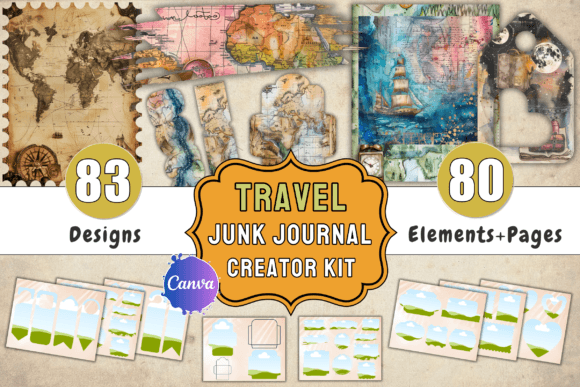
The visual characteristics are deeply rooted in tactile realism. The kit includes editable frames, stamps, and borders that act as visual anchors. When you place a product image inside one of the 10 editable frames provided, you aren't just cropping a photo; you are contextualizing it within a narrative. For a content creator or a small business owner, this is crucial. It transforms a standard Instagram post into a page from a travel diary. It shifts the viewer’s mindset from "I am looking at an ad" to "I am looking at a story." This aesthetic is particularly effective for brands that want to appear approachable, artisanal, or eco-conscious.
Practical Application: From Digital Templates to Print Assets
One of the most significant advantages of this system is the integration with Canva. As a designer or entrepreneur, you likely value speed alongside quality. The inclusion of two Canva Templates—one for elements and one for pages in standard US Letter size—means you can bypass the steep learning curve of complex software like Adobe InDesign or Photoshop. You can access these assets immediately and begin editing. This is a massive win for web design and social media graphics, where turnaround times are often measured in hours, not weeks.
However, the utility of the Travel Junk Journal Kit extends far beyond the screen. Because the core content includes 83 high-resolution 300dpi JPG pages, you have a robust foundation for physical print design. Consider the following applications where this kit shines:
- Packaging Design: If you sell physical goods like candles, teas, or handmade crafts, using the included envelopes and pockets as design references can elevate your unboxing experience. You can print custom tissue paper patterns using the digital papers or create hang-tags that look vintage and bespoke.
- Editorial Design: For indie publishers or bloggers creating lead magnets, the 15 editable journal pages provide a ready-made layout structure. Instead of staring at a blank canvas, you have a textured background that suggests a specific mood, helping to guide your visual hierarchy.
- Marketing Collateral: Create unique business cards, appointment cards, or loyalty stamps using the 5 editable stamp designs. In a stack of glossy, corporate business cards, a textured, journal-style card is memorable. It aids in brand recognition by engaging the sense of touch (visually, at least).
Design Strategy: Pairing and Professionalism
When working with a kit like this, your choice of typography becomes the deciding factor in whether the result looks professional or chaotic. The Travel Junk Journal Kit provides the texture, but you must provide the voice. A common mistake is pairing these vintage textures with overly ornate script fonts or heavy display fonts for body text. This kills readability.
Instead, treat the kit as the "art" and your type as the "explanation." For body copy—whether on a website or a printed pamphlet—stick to a clean sans serif font or a highly legible serif font. The contrast between the clean, geometric lines of a sans-serif and the organic, uneven edges of the journal elements creates a balanced visual hierarchy. For example, if you are designing a brochure for a travel agency, use the editable labels for headers and the textured paper for the background, but keep your pricing and itinerary details in a standard, professional typeface.
Furthermore, consistency is key to brand perception. Don't just use one element from the kit and discard the rest. The 15 editable labels, 10 editable tags, and 5 editable hearts are designed to work as a system. Use the tags for metadata or small details, and the labels for section breaks. This repetition of motifs builds a cohesive visual language that signals to your audience that your brand is thoughtful and detail-oriented. Whether you are a content creator making YouTube thumbnails or a designer building a logo design presentation, treating these assets as a unified system rather than isolated pieces will result in a much stronger, more professional output.
Ultimately, the Travel Junk Journal Kit + Canva Template is about giving you the building blocks of a narrative. It removes the friction of asset creation, allowing you to focus on the message you want to convey. By leveraging these high-quality digital components, you can produce work that feels handmade and personal, yet polished enough for commercial application.